Blackjack's Unseen Threads: How Table Position Shapes Wagering Patterns in Multi-Variant Free Play Environments
Written by Petra Franke · Nov 16, 2026
Blackjack's Unseen Threads: How Table Position Shapes Wagering Patterns in Multi-Variant Free Play Environments
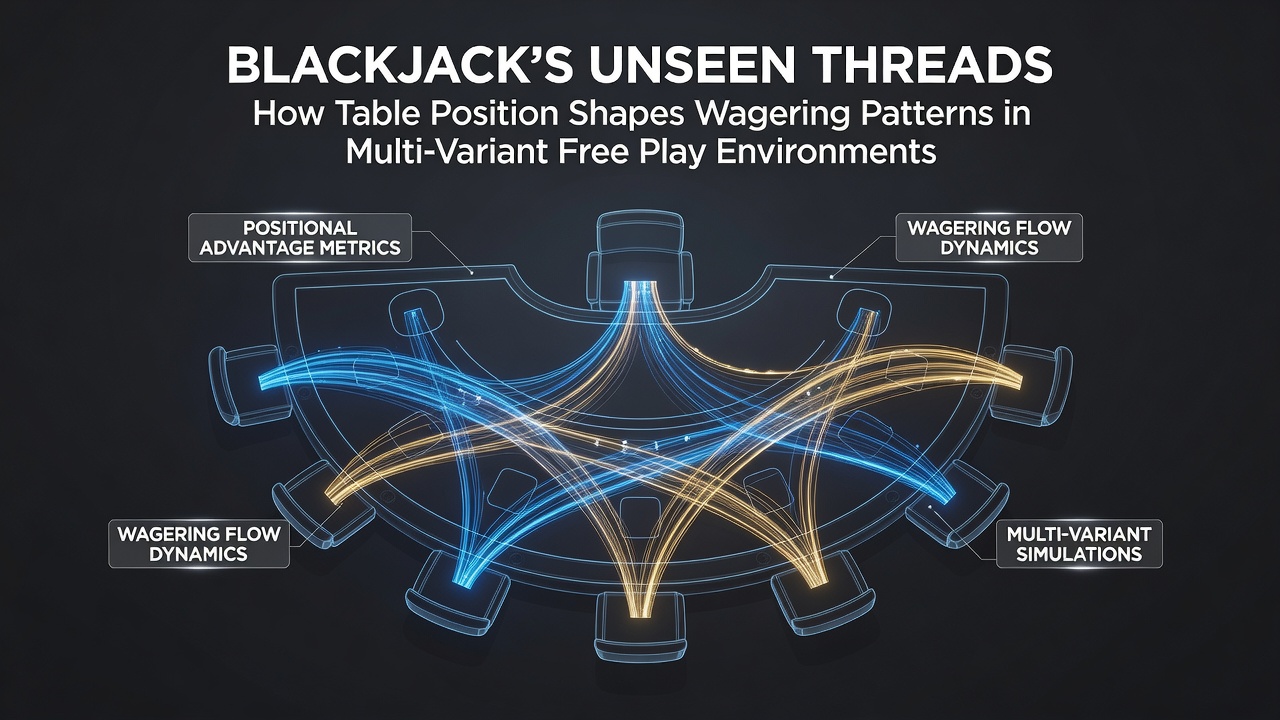
Table position in blackjack determines the sequence of decisions during each round, and data from free play environments across multiple rule variants shows measurable differences in how participants adjust their wagers based on that sequence. Early positions act before most other players reveal their outcomes, whereas late positions receive additional information from preceding hands. Researchers tracking user behavior in practice platforms have documented shifts in bet sizing that align with these informational advantages, particularly when variants alter dealer rules or deck penetration levels.
Position Mechanics Across Rule Sets
Free play simulators often incorporate variants such as dealer stands on soft 17, double after split permissions, and different numbers of decks. In these settings, players seated in the first two positions tend to place initial bets at consistent levels during early rounds, then adjust downward when the count turns negative according to simulation logs compiled through November 2026. Those in the final positions, by contrast, show wider bet spreads once they observe multiple completed hands, because the additional visibility influences their perception of remaining deck composition.
Studies conducted on platforms that randomize variant selection per session indicate that position-based patterns remain stable even when payout structures change. For example, sessions using six-deck shoes with surrender options produce higher average wager increases in late positions compared with two-deck games without surrender. The difference appears in aggregate data rather than individual strategy charts, suggesting the effect stems from sequential information rather than rule-specific deviations alone.
Wagering Adjustments Observed in Practice Modes
Simulation records reveal that participants in middle positions maintain steadier betting curves across hundreds of rounds. Early-position players exhibit more frequent small increases after strong initial hands, while late-position players demonstrate larger jumps following dealer bust sequences visible to them first. These trends hold across thousands of recorded sessions on platforms that log position and bet size simultaneously.

Analysis of multi-variant environments shows that when rules switch between rounds, late-position bet adjustments accelerate. One dataset from a European operator's practice module, cross-referenced with similar North American platform logs, found that the standard deviation of bet sizes in the anchor seat exceeded that of the first seat by roughly 18 percent under identical penetration settings. Such figures come from automated tracking rather than self-reported behavior.
Variant-Specific Influences on Position Effects
Variants that increase dealer advantage, such as continuous shuffling or restricted doubling, compress the range of observed bet spreads overall. Yet the relative gap between early and late positions persists. Data collected through late 2026 from several free-play networks indicates that late-position players still widen their wagers more aggressively when the running count improves, because preceding hands provide confirmatory signals before their turn arrives.
Platforms offering rapid variant rotation, where users encounter different rule sets within a single sitting, produce the clearest position-linked patterns. Early seats display conservative sizing regardless of the active variant, while late seats show variant-responsive sizing after the first few hands establish baseline outcomes. Researchers attribute this to the cumulative information advantage rather than any inherent preference for one rule set over another.
Statistical Correlations Documented in Aggregated Logs
Correlation coefficients between true count and bet size strengthen as position moves toward the anchor seat in most recorded multi-variant sessions. Nevada Gaming Control Board reports on practice environment analytics, along with parallel findings from the Malta Gaming Authority, confirm that these correlations appear consistently across thousands of user sessions. The effect size remains modest but repeatable when penetration exceeds 75 percent of the shoe.
Position also interacts with session length. Shorter practice runs under 50 rounds show minimal differentiation, whereas runs exceeding 200 rounds amplify the late-position advantage in wager scaling. Observers note that the pattern holds whether the variant includes side bets or remains limited to standard play, suggesting the driver is informational sequence rather than optional wager types.
Conclusion
Free play environments continue to supply detailed position-level data that links seating sequence to observable wagering adjustments across variants. Early, middle, and late positions generate distinct patterns in bet sizing and spread width, with late positions showing greater responsiveness to emerging count information. Aggregated records through November 2026 demonstrate these relationships persist under differing deck counts, dealer rules, and penetration levels, providing measurable benchmarks for how sequential information shapes participant behavior in controlled practice settings.